

The DREAMS 1-2-3 method begins with a simple fact: you create your dreams so you must know what they mean. This simple fact gives rise to an approach to dream interpretation that assumes you already know what it all means.
Want to go deeper?
Master the Art of Dream Interpretation
Learn the proven DREAMS 1-2-3 method used by thousands of dreamers — from the author with 25,000+ interpretations at r/dreams.
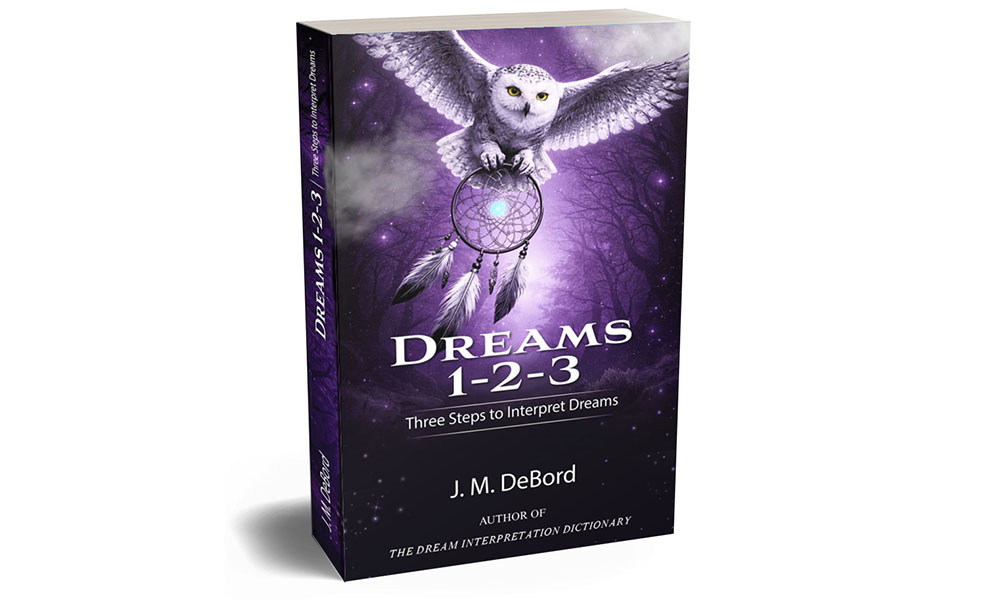
So today let’s see how that simple fact plus two more are the foundation for the next 300 pages of my forthcoming book DREAMS 1-2-3: Three Steps to Interpret Dreams by J. M. DeBord. The following excerpt is from the book’s introduction. On Feb. 23rd, launch day, I’ll post the link to the Amazon sales page. (Book will only be available in print.)
The Beginning
What do dreams mean? It’s a question most people can’t answer, especially for specific and personal dreams, because dream interpretation is no longer taught in most places, but the first simple fact offered by my DREAMS 1-2-3 method gives you a starting point, and it’s something obvious:
Subconsciously, you know what your dreams mean.
Since you create your dreams, you must know what they mean, right? I point out this simple, obvious fact to students at Owls School of Dreaming, and by following the logic they realize that a). they possess the power to interpret their own dreams, and b). dream interpretation helps them remember what they already know subconsciously.
My students also come to realize that dream interpretation is not as difficult as it can seem, it’s awesome for self-help and inner exploration, and it all begins with understanding the subconscious mind and its role in dreaming. Which brings us to the second simple fact about dreams:
Dreams are stories.
Like parables, dreams are little stories that teach and illuminate. To illuminate means to make clear and visible, or to clarify and explain. That sums up the purpose behind meaningful dreams, especially the ones that shine the brightest light, penetrate the deepest shadow and hit with the biggest realizations. Dreams are stories designed to help you learn through experience, which is the best teacher, after all. A story leads the reader on a journey to discover what the author already knows. Similarly, a dream starts with a destination in mind for what it wants you to know, then figures out the best way to get you there by telling a story. Gifted storytellers embed ideas in their stories for readers to discover on their own, leaving room to experience it all personally. Dreams do that, too.
By teaching with stories, dreams bypass your ego boundaries, and they train your body and mind. In fact, the rewiring of the brain known as neuroplasticity happens only while dreaming, and how you respond as a participant in the story influences this crucial process. Your dreams not only shape the person you are in the most fundamental ways, but they also show where you are at in life and where you are headed. Edgar Cayce said that nothing major happens in life without first being seen in a dream.
Tell me again why more people aren’t curious to find out what their dreams mean.
A dream usually begins as the outline of a story then drops you into the action as a participant or observer. The adventure proceeds from there based on your choices and how the dream incorporates them into the story. Which means that a dream is an interactive story, a choose your own adventure, and, pay attention, it is a co-creation between the ego part of the mind and the other structures of the psyche. The psyche includes what we call the subconscious, but from here forward we will use the term unconscious mind. The unconscious mind is a structure of the psyche, and the psyche is the totality of the mind.
Approaching dreams as stories makes them personal and knowable. Dream interpretation is an obscure subject, but stories are as familiar as the skin on your hands, and the ability to understand the meaning of stories (and dreams) is inborn. Stories are the original means of communicating knowledge and information. Every life is a story, so think of your dreams as the story of your life, especially your inner life, and your development as a human being. The story is communicated in a language of symbols, and since most people don’t know how to translate the language, few of us really understand the meaning of our dreams. Which brings us to the third and final simple fact:
Dreams use symbolism.
Symbolism is a language of symbols and gestures used in the context of a story or narrative to communicate meaning and ideas, similar to how a picture says a thousand words. With few exceptions, everything in a dream is symbolic, figurative, not literal—though to say it’s “not real” does injustice to the carefully-crafted experience. When it comes to dreams, appearances are deceiving because the meaning is obscured by the symbolism. This is why some people think dreams are meaningless; they haven’t been taught to translate the language.
Symbolism is the language of the unconscious mind; it’s how the mind and body communicate internally. Much of what you dream about is a pow-wow between your mind, body, and spirit, and the dream imagery is a graphical user interface that facilitates interaction between the ego and the underlying programming, mechanisms, and personalities of the psyche. The imagery is also a chronicle of that interaction.
A dream is an opportunity to experience interaction with the unconscious and conscious parts of oneself, with the unconscious parts comprising 95% or more of the total mind. This is the mind we strive to understand while interpreting dreams. Most of the mind exists below the threshold of conscious awareness, it is unconscious, or preconscious, as opposed to conscious, and its influence on thought processes, feelings, emotions, perceptions, and behaviors is fundamental. The agenda of the unconscious mind is to teach you how to develop your potential by showing you what you do not already know or understand.
In other words, it illuminates.
The DREAMS 1-2-3 method begins with three simple facts:
- You know subconsciously what your dreams mean because you create them.
- Dreams are interactive stories created primarily for the purpose of learning and growth through experience.
- Dreams speak the language of symbolism, and you understand it instinctively.
Get that straight and you are ready for the three simple steps:
- Identify a dream’s story elements and narrative components.
- Interpret the symbolism and analyze the story.
- Connect the dream’s details in context and reflect on your life.
Simple, right? Follow a three-step method, with some simple facts to guide you, and you gift yourself the awesome power to interpret your own dreams. I created DREAMS 1-2-3 to make it easier for you to step into and experience the endlessly fascinating world of dream interpretation. People think it’s too rarefied for anyone except a specialist or guru, but when explained step by step with simple language and lots of examples like in this book, dream interpretation is easier than you might think. Anyone can do it, and that includes you if you’re willing to put in the time. By reading this book and applying what it teaches, you will gain this rare knowledge and the ability to utilize it.
Does belief make a difference? I know so after witnessing my students grasp these teachings and use them to understand the meaning of a dream, perhaps for the first time ever, and from that moment forward they know they can do it, and are hooked. George Dantzig, a doctoral student at UC Berkeley, arrived late for class one day and saw two math problems written on the chalkboard by his professor. Not knowing they were famous unproven statistical theorems (which he’d have known if he’d arrived on time), he assumed they were homework, and therefore he believed they must be within his ability to solve. So he copied them down, worked all week at solving them, and succeeded, to the amazement of his professor, his classmates, and the math world. He credited his can-do belief for creating the right mindset to accomplish what was considered impossible at the time.
Yes, you can do this, you can interpret dreams, and you have come to the right place for instruction. Ahead is the deepest, most enlightening exploration of dream interpretation and analysis found anywhere, a feast of knowledge, information, and tools laid out for you to start digging into and employing right away to understand the meaning of your dreams.
Dreams elude comprehension because they are co-created with a side of the mind—the unconscious—that’s a mystery, yet the unconscious mind is the foundation for everything you are, and it’s knowable through working with and understanding your dreams. The effort you put into understanding your dreams and the unconscious is one of the best things you will ever do for yourself. So, welcome.
Behind the scenes of the dreaming process, you are the author. You are the characters, the settings and the symbols. You are also the audience, the critic and everything else. Dreams tell the story of your life as it’s written, and you not only tell the story but also receive it. You are the author and the reader. It all begins and ends with you!
An entire dream can be too much to digest at once. That’s why DREAMS 1-2-3 takes you step by step, beginning with Step 1: Story Elements and Narrative Components. It’s basic detective work:
Get the facts.
Pursue the leads.
Connect the dots.
Now let’s get the facts.
Excerpt concluded. Getting the facts is Step 1 of the DREAMS 1-2-3 method. I teach it all in great detail and with hundreds of fascinating examples in the book.

About the Author
J.M. DeBord — known online as RadOwl — has published over 25,000 dream interpretations at r/dreams, Reddit’s largest dreaming community, which he has moderated since 2014. He is the author of DREAMS 1-2-3: Three Steps to Interpret Dreams and The Dream Interpretation Dictionary. Recognized by the International Association for the Study of Dreams. Former dream expert-in-residence at Canyon Ranch Spa Tucson. Featured in The Guardian and a recurring guest on Coast to Coast AM.
Leave a Reply