The word “archetype” gets thrown around a lot in dream interpretation circles, and it almost always gets watered down in the process. You’ll see lists of common archetypes with neat definitions next to each one, as if the shadow is just “the dark side of the personality” and the Anima is just “your feminine aspect.” Technically accurate. Practically useless.
Want to go deeper?
Master the Art of Dream Interpretation
Learn the proven DREAMS 1-2-3 method used by thousands of dreamers — from the author with 25,000+ interpretations at r/dreams.
Archetypes aren’t categories. They’re forces. And when they show up in your dreams, they don’t come with a label — they come with a charge. Something about the dream grabs you in a way that goes beyond personal significance. The imagery feels larger than your own life. The emotional intensity is out of proportion to the surface content. That’s usually the tell.
Jung’s core insight was that the psyche has depth — that below the personal level of the unconscious, where your own memories and repressions live, there’s a deeper layer that all humans share. The archetypes are the inhabitants of that layer. They’re not things you invented; they’re things you inherited, baked into the structure of the psyche by millions of years of human experience.
The shadow: the most important dream character you’re not looking at
The shadow is the most documented and most misunderstood archetype in the Jungian system. It’s not evil. It’s not the dark side of your personality in any simple moral sense. It’s everything about yourself that you’ve decided not to be — the traits you’ve repressed, denied, or disowned because they didn’t fit the person you chose to become.
That material doesn’t go away. It goes underground, and it finds ways to run your behavior from below the floorboards. The shadow appears in dreams as the rejected figure — the threatening stranger, the enemy, the dark pursuer. Whatever you’re running from in the dream is worth a second look.
Ryan Hurd’s conversation — “The Power of Dreams Compels You” — goes into this with more sophistication than most. As a dream researcher, Ryan brings both intellectual rigor and personal experience to the question of what it means to face the shadow in a lucid dream — what happens when you stop running and turn toward the thing chasing you.
The Anima and Animus: your inner opposite speaks
For men, the Anima is the unconscious feminine — not in any biological sense, but as a structural feature of the male psyche that carries the relational, emotional, and creative capacities that masculine identity often suppresses. For women, the Animus plays the corresponding role.
Steve Ernenwein’s episode — “The Father Wound” — is one of the clearest accounts of Anima work I’ve heard told in plain language. He uses Star Wars as the mythic container (the unconscious works with whatever mythology is live for you), and the dreams he shares trace a very specific arc: from refusing to own his creative fire and worth, to being confronted with that refusal through dream imagery, to finally accepting what the Anima was asking him to claim.
The Warrior and the Mythic Dream
When the unconscious needs to communicate something about the soul’s journey — not just your personal situation but the archetypal task you’re in the middle of — the imagery gets mythic. Larger-than-life settings. Epic scenarios. A feeling that the stakes in the dream are somehow cosmic.
Lawrence’s story in “The Burning Man and the Warrior’s Way Home” works the Warrior archetype at full scale. His closing words drew from the opening pages of Jung’s Red Book — because what he was describing wasn’t a personal story about PTSD and war. It was a mythic story about what it means to carry a warrior’s soul in a world that doesn’t know what to do with that.
Jason’s own Season 4 episode — “In the Name of the Father” — is another example of the mythic dream in action. The dreams were giving him the frame for where he stood in a larger story, not just the immediate circumstances. That’s what mythic dreams do: they locate you in an arc bigger than your biography.
The archetype you didn’t know was there
Leah’s episode — “The Amazon Woman and the Stories Inside Us” — happened in real time on the show. She came in without a theory about what her dreams meant, and the work of the episode was watching the archetype get identified, named, and understood while the recording was running. The Amazon Woman had been appearing in her dreams in the middle of postpartum depression, and the eruption of that material was overwhelming precisely because it carried so much autonomous energy.
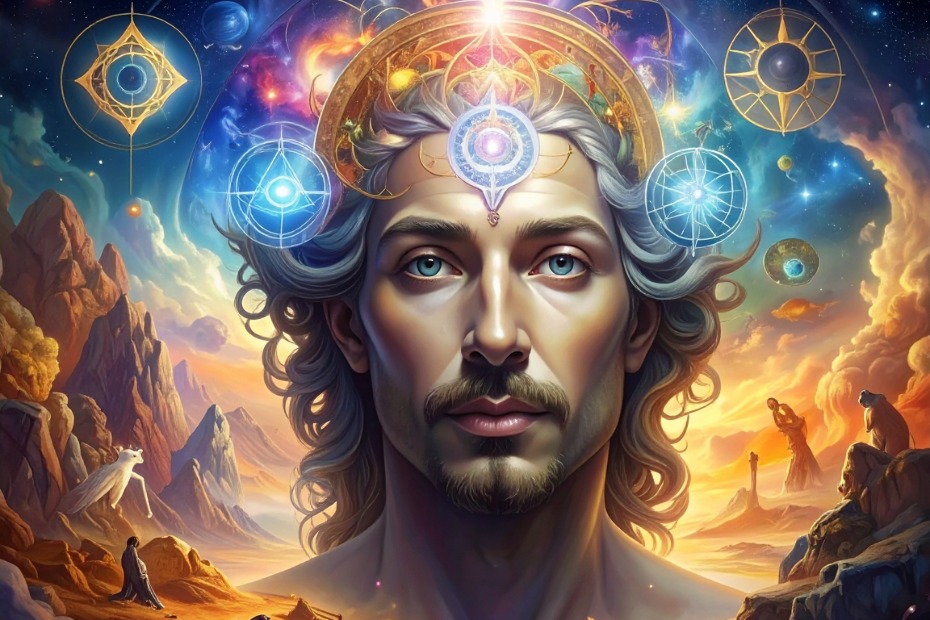
The dreams I’ve experienced that featured archetypal characters and themes are the most powerful I’ve ever experienced. The “Jesus” dream is one I’ll never forget. There I was on a rolling hillside, looking at thousands of people gathered for something that must be important. Suddenly, I feel a presence and everyone drops to one knee. I look over and there’s Jesus. He says, “To follow me, you must carry these” and with a sweep of the arm he indicates the masses. Next thing I know, there’s an infirm older man supporting himself by holding onto my shoulder. The look on his face poses a question: are you all right with this? I decide on the spot that yes, he can use me for support. Just a quick scene embedded in a larger sequence of dream imagery, but it shaped my life. Just one moment experienced in that dream gave me clear instructions, as opposed to all the Christian dogma I’d been fed about Jesus.
Jungian dreamwork is one of the most sophisticated systems for understanding why certain dreams feel so different from ordinary ones. The archetypes aren’t a checklist — they’re living forces in the psyche, and they show up in your dreams because they have something specific they want you to do.
Dreams That Shape Us goes deep into the Jungian dimension of real dreamers’ lives. Find it on Spotify or Apple Podcasts, or browse episodes at dreamsshapeus.com.
For a systematic approach to working your own dreams — including the big, charged ones — the DREAMS 1-2-3 method at dreams123.com is where to start.

About the Author
J.M. DeBord — known online as RadOwl — has published over 25,000 dream interpretations at r/dreams, Reddit’s largest dreaming community, which he has moderated since 2014. He is the author of DREAMS 1-2-3: Three Steps to Interpret Dreams and The Dream Interpretation Dictionary. Recognized by the International Association for the Study of Dreams. Former dream expert-in-residence at Canyon Ranch Spa Tucson. Featured in The Guardian and a recurring guest on Coast to Coast AM.
Leave a Reply